
Storage units for offices are dedicated, secure spaces that businesses can rent to store items they don’t have room for on-site. Think of them as a flexible, off-site extension of your storeroom, perfect for everything from archiving documents and holding surplus furniture to managing seasonal inventory. It’s a smart solution for businesses looking to reduce office clutter and improve efficiency without the high cost of leasing more commercial space.
Why Your Business Needs More Than Just Office Space
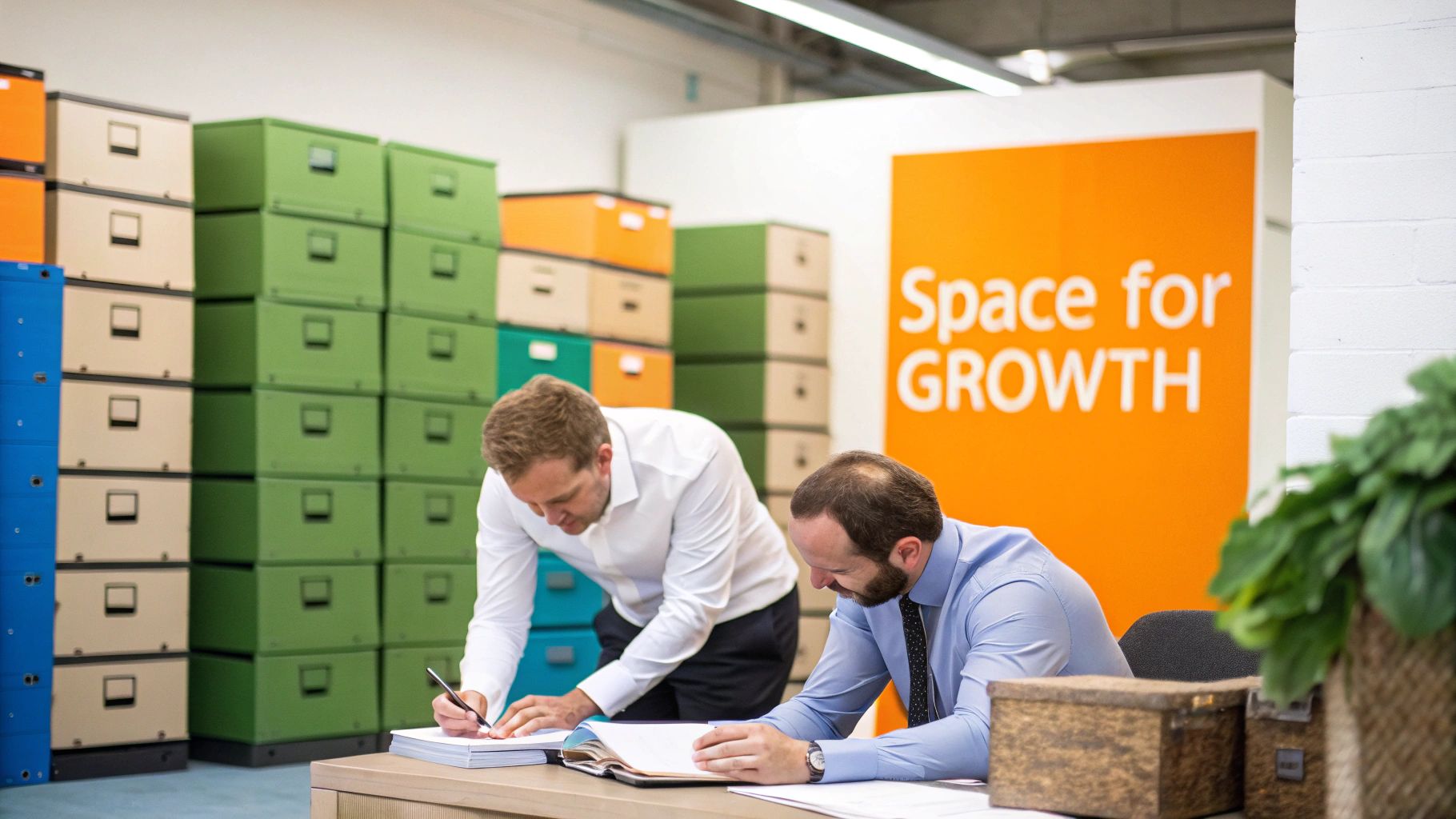
This image nails the ideal modern workplace—clean, organised, and productive. It’s a state that’s often hard to achieve without a little help from external storage.
The modern UK workplace is changing. As companies get comfortable with hybrid work and rethink their physical footprint, the traditional office often struggles to keep up. The result? A common set of challenges that can directly hamper productivity and growth.
The Everyday Struggles of a Crowded Office
For many businesses, clutter doesn’t happen overnight; it’s a slow creep. File cabinets start overflowing, spare desks and chairs begin lining the corridors, and promotional materials gradually take over valuable floor space. This isn't just an aesthetic issue; it’s a real operational bottleneck.
A disorganised environment slows down daily tasks, frustrates employees, and can project an unprofessional image to any clients who visit. It’s a problem that’s reflected in the market itself. The UK office storage and organisation sector was valued at around USD 1,005.9 million in 2024, with filing cabinets still leading the charge. This tells us there's still a heavy reliance on in-office solutions, even as new work patterns demand more adaptable approaches. You can learn more about the trends shaping the UK office furniture market here.
Storage units for offices act as a strategic release valve. They allow you to reclaim expensive office square footage for what it’s best at—powering collaboration and core business activities—while safely housing the items that support those functions from a distance.
A Strategic Tool for Business Agility
Just seeing a storage unit as an "extra closet" really misses the point. It’s a powerful tool that gives your business agility. Whether you're planning an office renovation, managing a temporary flood of inventory, or downsizing to a more cost-effective hybrid workspace, off-site storage provides the essential buffer you need to make it happen smoothly.
It offers a secure, scalable solution that adapts to your changing needs, empowering you to make smart operational decisions without being held back by physical space. It’s all about decluttering your path to success.
The Real-World Benefits of Business Storage
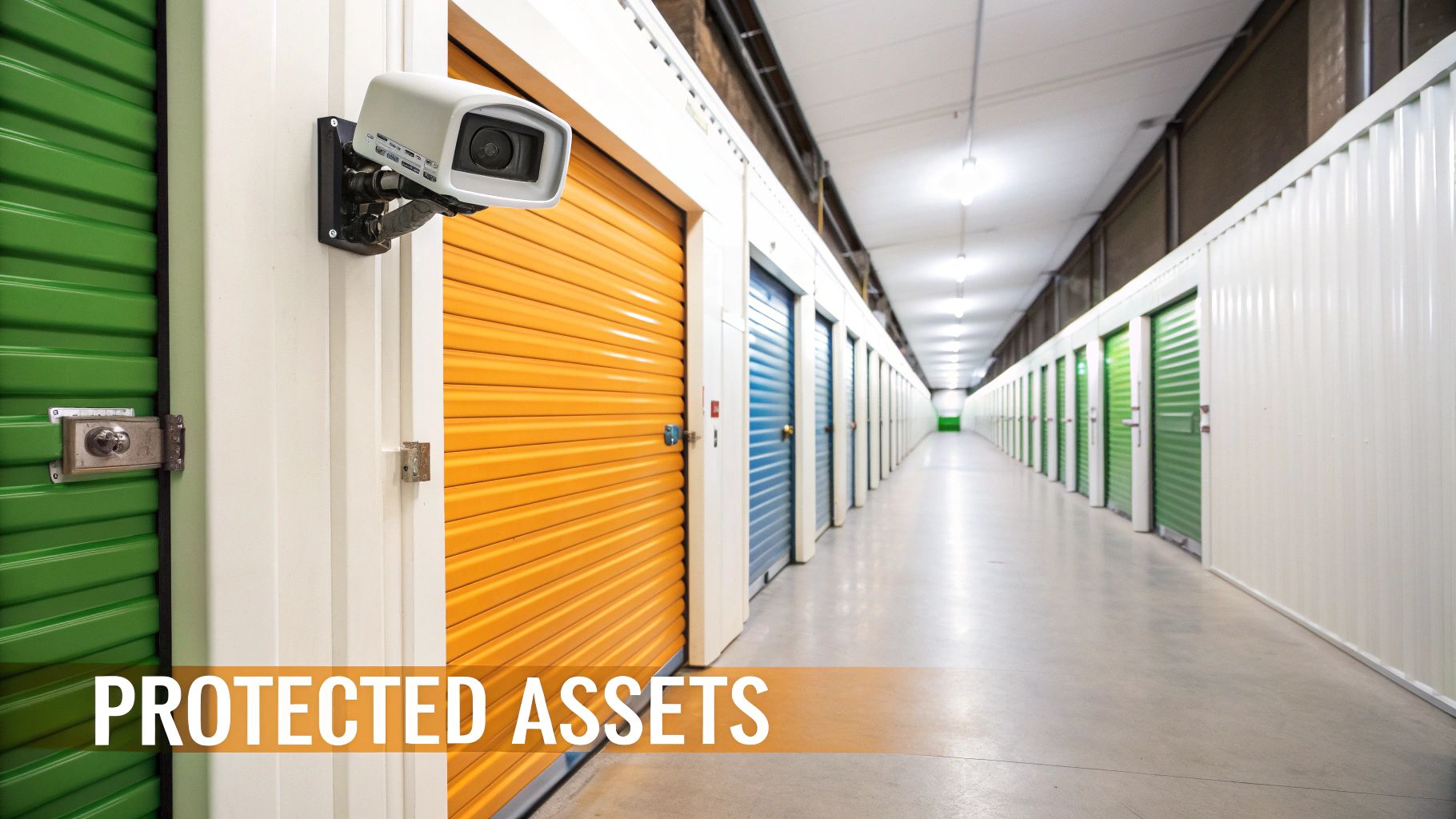
Thinking beyond a simple declutter reveals the true return you get from storage units for offices. It’s not just about making the workspace look tidier; it’s a smart move that brings real financial, security, and operational wins. These benefits hit your bottom line and give your company the room it needs to adapt and grow.
By moving non-essential items off-site, you get to unlock the full potential of your main commercial space. Your office stops feeling like a crowded storeroom and goes back to being a dynamic hub for productivity, client meetings, and teamwork.
Significant Cost Savings Compared to Leasing
One of the strongest arguments for business storage is the straightforward financial sense it makes. Leasing extra commercial office space is a major, long-term financial drain. In contrast, renting a storage unit is a much more affordable and flexible way to handle overflow.
Just think about the cost per square foot. Commercial rent in prime UK locations can be eye-watering, locking you into expensive leases for space you might only use for boxes and files. A self-storage unit gives you that same space for a fraction of the price, without the headache of business rates or long-term contracts.
A storage unit allows your business to pay only for the extra space it needs, exactly when it needs it. This financial agility is crucial for managing cash flow, especially for small to medium-sized enterprises (SMEs) looking to control overheads while scaling their operations.
This flexible approach is fast becoming a core part of modern business strategy. In fact, 24% of storage unit users are now running parts of their businesses directly from their units, which just goes to show how essential these spaces have become for SMEs and mobile enterprises. You can see more data on the growing importance of self-storage for UK businesses.
Enhanced Security for Valuable Assets
Your office might feel secure, but is it actually designed to protect high-value assets and sensitive documents around the clock? Most office buildings have their limits, with security mainly focused on controlling who comes and goes during business hours. Professional storage facilities, on the other hand, are built from the ground up with security as the number one priority.
These facilities offer layers of protection that a standard office simply can’t compete with. This multi-layered approach ensures your assets are properly safeguarded against theft, damage, and anyone who shouldn’t be near them.
Key security features often include:
- 24/7 CCTV Surveillance covering all key access points and corridors.
- Secure Perimeter Fencing to deter any unauthorised entry onto the site.
- Controlled Gate Access that requires a unique code or key fob to get in.
- Individually Alarmed Units for an extra layer of protection on your specific space.
This level of security is vital for storing everything from confidential client archives and legal documents to expensive IT equipment and specialised tools. It gives you genuine peace of mind that your business's physical assets are protected by professional-grade systems.
Unlocking Operational Flexibility and Growth
Perhaps the biggest advantage of using storage units for offices is the incredible operational flexibility they offer. This agility lets your business react quickly to new opportunities and challenges without being held back by physical space. It acts as a buffer, making transitions smoother and operations more efficient across different scenarios.
A storage unit can be a huge support during key moments of change:
- Office Moves or Renovations: Store furniture and equipment safely to keep disruption to a minimum.
- Seasonal Inventory Management: Hold extra stock for busy periods without cluttering your main workspace.
- Archiving Documents: Free up prime office real estate by storing legally required documents securely off-site.
- Supporting Hybrid Work Models: Downsize your main office while keeping essential assets easily accessible.
Ultimately, a storage unit empowers your business to operate more effectively. It helps with seamless office relocations, managing fluctuating stock levels, and supporting the shift to more agile ways of working, ensuring you have what you need, right when you need it.
How to Choose the Right Storage Unit Size
Picking the right size for your office storage unit can feel like a bit of a guessing game. If you go too small, you'll end up playing a frustrating game of Tetris with desks and boxes. Go too large, and you’re just paying for empty air. The trick is to stop thinking in abstract square footage and start visualising your items in a real-world context.
Think of it like this: you wouldn't hire an entire lorry just to move a couple of boxes, but you also wouldn't try to cram a whole office into the back of a small van. Choosing the right unit size is the exact same principle. When you match what you need to store with the unit’s capacity, you’re setting yourself up for an efficient and cost-effective solution right from the start.
Visualising Common Unit Sizes
To make things a bit easier, let's break down the most common storage unit sizes using some relatable analogies. This should help you picture exactly what fits inside and take the guesswork out of the decision. Each size is designed to meet a specific business need, from stashing a few archive boxes to holding the entire contents of a small office.
A great first step is to do a quick inventory of everything you plan to store. Group things by type—documents, furniture, equipment, and stock—to get a clearer idea of the total volume you're working with. For an even more detailed breakdown, our comprehensive self-storage unit size guide offers extra visuals and tips to help you choose with confidence.
Small Units From 25 to 50 sq ft
Small storage units for offices are a game-changer for businesses that need to clear out a cramped storeroom or archive documents without taking up valuable office space.
- 25 sq ft Unit (Roughly the size of a large telephone box): This compact space is perfect for about 40-50 standard archive boxes. It’s the ideal solution for a solicitor's office that needs to hang onto client files or a small business archiving old financial records.
- 50 sq ft Unit (Comparable to a large garden shed or a transit van): With this size, you get a lot more room to play with. You could comfortably fit the contents of a small one-person office, including a desk, an office chair, a filing cabinet, and around 80-100 archive boxes. It's an excellent choice for a start-up moving into its first proper workspace.
These smaller units are brilliant for decluttering and creating a more organised, productive work environment without having to commit to a massive space.
Medium Units From 75 to 150 sq ft
When you're storing more than just documents and a few bits of furniture, medium-sized units hit that sweet spot between space and value. They’re incredibly versatile, making them a popular choice for businesses with seasonal stock, bulky equipment, or those undergoing a minor refurbishment.
Think of a medium unit as your off-site stockroom. It’s large enough to hold a good amount of inventory or equipment but still manageable and easy to organise, so you can get to things quickly. This flexibility is what makes it one of the most popular choices for growing businesses.
- 75 sq ft Unit (Similar to a single garage): This can hold the furniture and contents of a one or two-person office. It’s well-suited for storing a couple of desks, chairs, multiple filing cabinets, and a decent volume of boxes.
- 100 sq ft Unit (The size of a large single garage): A popular choice for retailers managing seasonal inventory or e-commerce businesses holding stock. It can easily accommodate larger items like display stands, marketing materials, and pallets of goods.
- 150 sq ft Unit (Comparable to a garage and a half): Ideal for tradespeople storing tools and materials or for a larger office storing surplus furniture. You could fit bulky equipment, extensive shelving units, and the contents of a 4-5 person office in here.
Office Storage Unit Size Guide
To give you an even clearer picture, here’s a quick-reference table. Use it to estimate the right unit size based on the kind of office items you plan to store.
| Unit Size (sq ft) | Comparable To | What It Can Typically Hold | Ideal For |
|---|---|---|---|
| 25 sq ft | Large telephone box | 40-50 archive boxes, a few small office electronics. | Document archiving, storing excess stationery, freeing up a small cupboard. |
| 50 sq ft | Large garden shed | A desk, chair, filing cabinet, and 80-100 archive boxes. | Storing the contents of a one-person office or a start-up's initial equipment. |
| 75 sq ft | Single car garage | Contents of a 1-2 person office, including several desks, chairs, and multiple filing cabinets. | Small office moves, storing furniture during a minor refurbishment. |
| 100 sq ft | Large single garage | Pallets of stock, display stands, marketing materials, and office furniture. | E-commerce stock management, storing seasonal retail inventory. |
| 150 sq ft | Garage and a half | Contents of a 4-5 person office, bulky equipment, tools, and materials. | Tradespeople's equipment storage, holding surplus furniture for a growing office. |
| 200+ sq ft | Double car garage | Entire contents of a 5-7 person office, including conference room furniture and IT equipment. | Complete office relocations, large-scale renovations, or warehousing stock. |
This table should help you narrow down your options, but remember it’s always better to have a little extra room than not enough!
Large Units 200 sq ft and Above
For the big jobs—like a full office relocation, a major renovation, or warehousing a serious amount of stock—a large storage unit is non-negotiable. These spaces give you the volume you need to handle substantial business assets, making sure everything stays secure and organised in one place.
A 200 sq ft unit, for example, is about the size of a double garage. It can comfortably hold everything from a 5-7 person office, including all the desks, chairs, IT equipment, conference room furniture, and hundreds of boxes. This makes it an invaluable tool for facilities managers who are overseeing complex logistical projects.
By taking a moment to assess what you need and using these real-world comparisons, you can confidently pick the right-sized storage unit for your office, making sure you get maximum value and efficiency out of your space.
Key Security Features Your Business Cannot Ignore
When you’re entrusting your company’s assets to an off-site facility, security isn’t just a feature—it’s everything. It’s not about slapping a strong lock on a door and calling it a day. We’re talking about a comprehensive, multi-layered system designed to protect your documents, equipment, and inventory from every conceivable threat.
Choosing the right storage units for offices means vetting a facility’s security with the same eagle-eyed diligence you’d apply to your own premises. Think of it like this: your office has a front door lock, but a dedicated storage facility should be a fortress. The best sites create layers of defence, making sure that even getting close to your unit is a challenge for anyone without authorisation.
This infographic gives a clear picture of what kind of items—from files to furniture—businesses typically need to secure in storage.
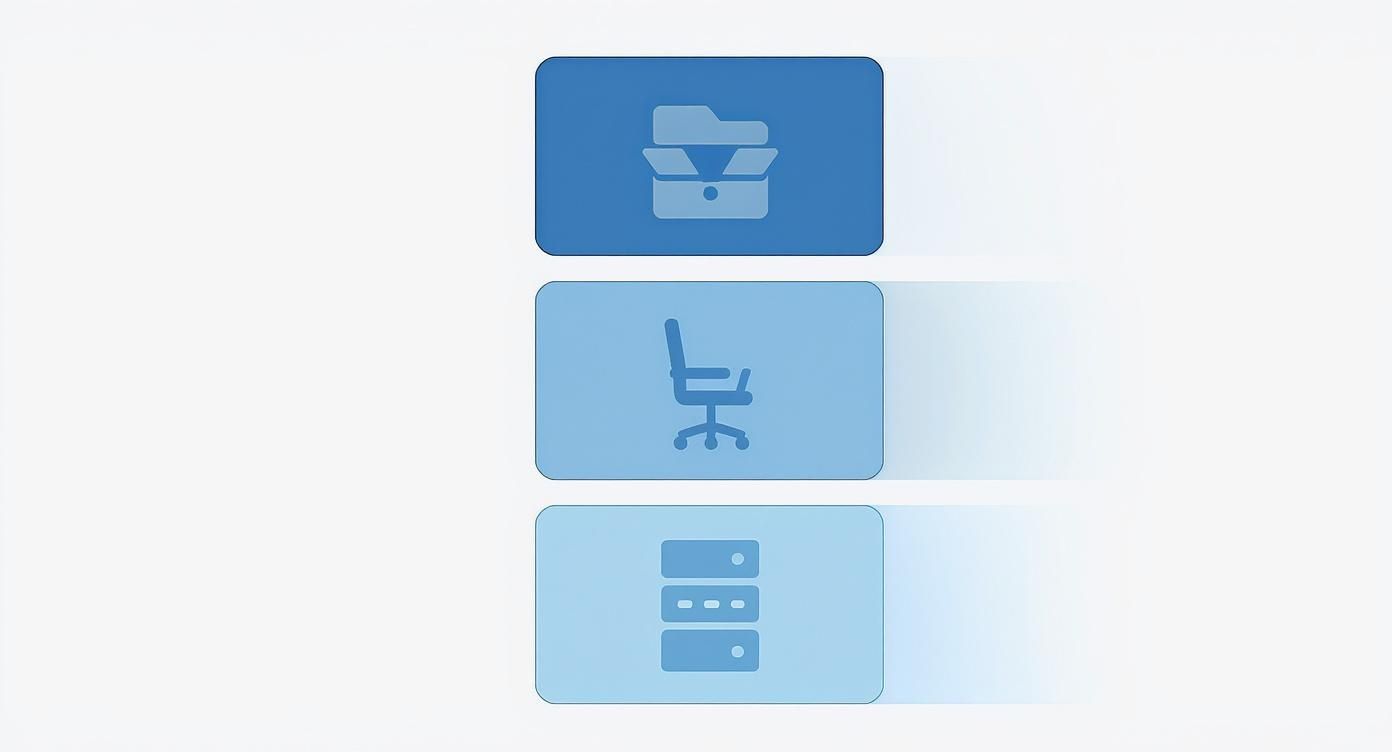
As you can see, whether you're storing sensitive documents or bulky equipment, each category of item demands its own level of security and space.
Foundational Security Measures
Before you even think about signing a rental agreement, there are a few foundational security features that must be in place. These are the absolute basics, the non-negotiables that form the backbone of a truly secure facility.
A must-have starting point is 24/7 CCTV surveillance. And I don’t just mean a single camera at the front gate. You want comprehensive coverage of all entry points, corridors, and high-traffic areas. This continuous monitoring acts as both a powerful deterrent and a crucial record-keeping tool. Alongside this, look for secure perimeter fencing that clearly defines the site and prevents casual entry.
The most effective security systems are proactive, not reactive. They are designed to prevent incidents from happening in the first place, rather than just documenting them after the fact. This proactive stance is what separates a standard storage provider from a professional one.
Finally, controlled gate access is essential. A facility that lets anyone drive in and out without verification is a massive red flag. Modern systems use unique PIN codes or key fobs, creating a digital log of everyone who enters and exits the premises. This ensures only authorised personnel can get access, adding a critical layer of control. To get a better feel for what's out there, it’s worth looking into the best commercial security systems available today to see how a facility’s setup stacks up.
Advanced Protection for Business Assets
Once you're past the perimeter, the security of your individual unit becomes paramount. This is where advanced features come into play, offering targeted protection right where your assets are stored. These measures ensure that even if someone were to get past the initial defences, your goods would remain safe.
Individually alarmed units are a huge step up from a simple padlock. These systems trigger an immediate alert if your unit is tampered with, prompting a swift response to a potential breach. What's more, having on-site management during business hours adds an invaluable human element. A visible staff presence not only deters would-be thieves but also ensures that any issues are sorted out promptly.
You should also ask about fire safety systems. Professional facilities will have comprehensive measures in place, including smoke detectors and fire extinguishers, to protect your items from accidental damage. Understanding the full scope of a provider's security is vital, which is why researching what makes for truly secure storage near me is such a critical step in the process: https://www.standbyselfstorage.co.uk/secure-storage-near-me/.
Access Hours and Insurance Considerations
Security isn’t just about keeping people out; it’s also about letting the right people in at the right time. The distinction between standard access hours and 24-hour access is a key operational point. If your business runs outside the typical 9-to-5, you’ll need a facility that can accommodate your team without compromising on security protocols during off-peak hours.
Lastly, never overlook insurance. A reputable facility will require you to have insurance cover for your stored goods. You need to clarify whether their policy is sufficient for your business assets or if you need to extend your own commercial policy to cover everything in storage. Asking these direct questions ensures there are no gaps in your protection, giving you complete peace of mind.
Organising Your Storage Unit for Maximum Efficiency
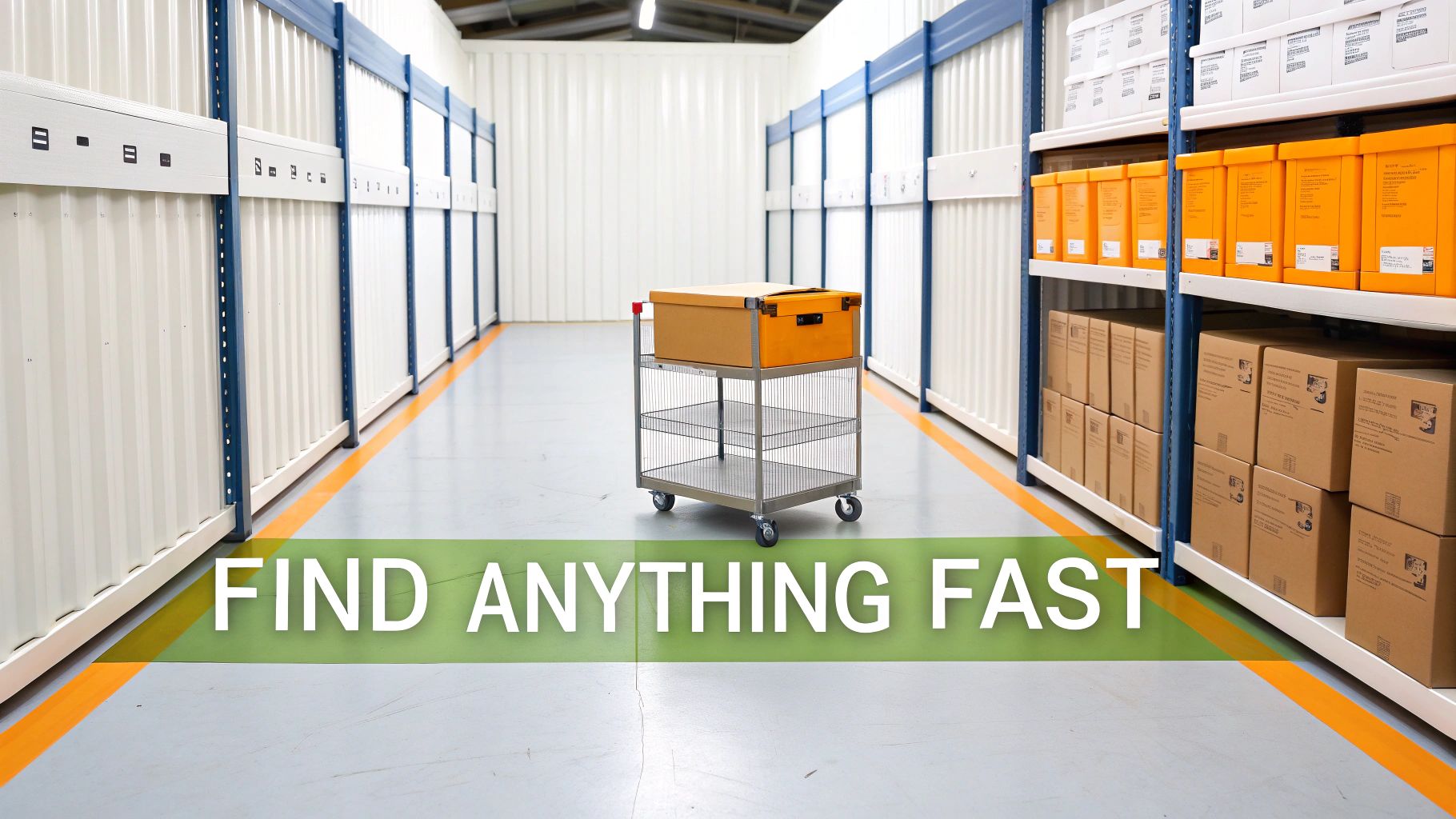
Renting a storage unit for your office is only half the battle. The real value comes from turning that space into an organised, efficient extension of your workplace. Without a clear system, your unit can quickly become a chaotic dumping ground where finding anything feels like an impossible task. The goal is to create a functional space where you can grab what you need, quickly and effortlessly.
Treating your storage unit with the same organisational rigour you apply to your main office is the key. A simple investment of time upfront to plan the layout and catalogue your items will pay you back tenfold later on. This approach transforms the unit from a simple box into a high-performance asset for your business.
Create a Strategic Floor Plan
Before you move a single box, sketch out a simple floor plan. Your main objective should be to create clear aisles for easy movement. Think like a warehouse manager: you need to be able to walk from the entrance right to the back of the unit without climbing over a mountain of stuff.
This layout plan should also designate specific zones for different categories. For instance, you could allocate one wall for document archives, another for surplus furniture, and a third for marketing materials. This zoning strategy stops items from getting jumbled up and makes finding them much more intuitive.
To help you get started, here are a few foundational steps:
- Place frequently needed items at the front. Anything you expect to access regularly should be positioned near the door for grab-and-go convenience.
- Keep heavy items on the floor. Store bulky furniture and heavy equipment on the ground to prevent lifting injuries and create a stable base for stacking.
- Use vertical space wisely. Invest in some freestanding shelving units to stack boxes and smaller items safely, making the most of every square foot.
Implement a Robust Inventory System
An inventory system is your map to everything in storage. Without one, you're flying blind. You don't need anything complicated; a simple spreadsheet is all it takes to create a master inventory list that details the contents of every single box.
Each box should get a unique number and a clear label describing its general contents. Think "Box 14 – 2023 Financial Records" or "Box 22 – Exhibition Stand Banners". This information then gets logged on your master spreadsheet.
A detailed inventory list is non-negotiable for efficient office storage. It removes all guesswork, allowing any authorised team member to locate a specific item in minutes. This saves valuable company time and cuts down on a lot of frustration.
Best Practices for Packing and Stacking
How you pack and stack your items has a direct impact on their condition and how easily you can get to them. Using uniform, sturdy boxes makes stacking much safer and more stable. It's tempting to use old, flimsy boxes, but they can easily collapse under weight, so it's best to avoid them.
When packing, make sure sensitive electronics are wrapped in anti-static bubble wrap and put back in their original packaging if you still have it. For document archives, use specialised archive boxes that are designed to protect paper from moisture and dust over the long term.
When it's time to stack, always place heavier boxes at the bottom with the lighter ones on top. Never stack boxes so high that they become wobbly, and always leave a small gap between your stacks and the unit walls to allow for air circulation. For a deeper dive, you can get more expert advice on how to effectively organise your self-storage container.
How Technology Is Reshaping Business Storage
The days of dusty, forgotten lock-ups are long gone. The modern self-storage world has seen a massive shift, driven by tech that makes managing your off-site items simpler, smarter, and way more secure. For businesses, this means today’s storage units for offices offer much more than just space—they deliver a slick service that fits right in with the fast pace of a modern company.
Think of it like the switch from traditional banking to online banking. You no longer have to pop into a branch during set hours to manage your finances. In the same way, digital platforms now let you handle your business storage from anywhere, at any time, turning a once-clunky task into a few simple clicks.
The Rise of Digital Management
One of the biggest game-changers has been the move to online management. Gone are the days of endless paperwork and in-person visits just to rent a unit. Modern facilities now offer intuitive online portals where you can:
- Browse and Book Instantly: See what unit sizes are free, compare prices, and get the entire booking sorted online.
- Manage Payments Digitally: Set up automatic payments or settle up from your computer or phone, ditching the hassle of manual invoicing.
- Control Access: At some of the more advanced spots, you can even manage who on your team gets access, all through a digital dashboard.
This digital-first approach frees up valuable admin time and gives businesses a much clearer, tighter grip on their storage arrangements. It makes the whole process incredibly efficient, from the initial booking right through to day-to-day use.
Smarter Security and Operations
Technology is also seriously beefing up the security of your business assets. Beyond the standard CCTV, facilities are now rolling out more sophisticated systems. AI-powered security monitoring can intelligently spot unusual activity, giving you a higher level of proactive protection for your valuable documents and equipment. For businesses wanting to integrate modern solutions, looking into options like smart locker systems can offer even greater security and efficiency.
This embrace of tech is happening across the board. The UK self-storage sector has seen impressive growth, with total floorspace set to expand by 7.2% between 2023 and 2025, hitting around 64.3 million square feet. A huge part of this growth is down to tech adoption, with about 68% of operators now using AI to fine-tune everything from security to customer service.
This operational efficiency, often driven by a lean staffing model of just 2.6 employees per site, is a direct result of technology. It allows facilities to focus resources on maintaining high standards of security and service, which ultimately benefits the businesses that rely on them.
When you see these industry shifts, it’s clear that modern storage units for offices are no longer just passive spaces. They’re active, tech-enabled partners that provide the flexibility, security, and efficiency that today’s businesses need to thrive.
Common Questions About Office Storage Units
Deciding to use off-site storage is a smart move for any business, but it's natural to have a few questions before you commit. Getting clear, straightforward answers is the key to making a confident decision that genuinely helps your operations. Let's walk through some of the most common queries we hear when businesses are looking at storage units for their offices.
Think of this as your essential pre-booking checklist. By getting these points sorted upfront, you can make sure your storage experience is smooth, secure, and flexible from day one, avoiding any surprises down the line.
What Kind of Insurance Do I Need?
This is one of the most important questions to ask, because protecting your business assets is non-negotiable. Any reputable storage facility will require you to have insurance cover for your items. This isn't just a suggestion; it’s a standard part of the rental agreement designed to protect both you and the facility.
You generally have two main options here:
- Facility-Provided Insurance: Many storage providers offer their own insurance policies, which you can conveniently add to your monthly rental fee. This is often the simplest route, as the cover is specifically designed for items held in storage.
- Your Own Business Policy: You might be able to extend your existing commercial business insurance to cover items stored off-site. It's vital to have a chat with your insurance provider to confirm your policy offers adequate cover for goods in a third-party facility.
Before you sign anything, always clarify what the cover includes, what it protects against (like theft, fire, or flooding), and any excess you might need to pay in the event of a claim.
Are There Restrictions on What I Can Store?
Yes, for safety and legal reasons, every storage facility has a list of prohibited items. These rules are in place to protect your goods, the belongings of other customers, and the facility itself. While the specifics can vary slightly between providers, some items are almost universally off-limits.
Commonly restricted items include:
- Flammable or Combustible Materials: Things like petrol, paint, solvents, and gas canisters are a definite no.
- Perishable Goods: Any food items that can spoil and attract pests.
- Living Things: This one’s pretty straightforward – no plants or animals.
- Illegal or Stolen Goods: Storing anything illegal is strictly forbidden.
Always ask for the complete list of restricted items before you start packing. It ensures you stay on the right side of your rental agreement and keeps things hassle-free.
How Flexible Are the Rental Contracts?
Business needs can change in an instant, so you need flexibility. The good news is that most modern storage units for offices are rented on highly flexible terms. The industry standard is a month-to-month rental agreement, which is perfect for businesses that need to stay agile.
This month-to-month model means you aren't locked into a long-term lease. You can easily upsize or downsize your unit as your inventory fluctuates or end your contract when a project is complete, often with minimal notice.
This kind of flexibility allows you to use storage as a dynamic tool that scales with your business needs, rather than treating it as a fixed, long-term overhead.
Ready to create more space for your business to thrive? At Standby Self Storage, we offer flexible, secure, and convenient storage solutions tailored for your office needs. Book your unit online today and see how easy it is to declutter your workspace.