

Smart businesses don't just see storage units as extra space—they see them as a strategic asset. It's a way to manage inventory, secure equipment, and scale operations without getting locked into a long-term commercial lease.
How Smart Businesses Use Storage to Drive Growth
Forget the old image of a dusty lock-up filled with forgotten junk. Today’s self-storage facilities are dynamic hubs that help businesses operate more efficiently and jump on growth opportunities when they arise. For many companies, a storage unit is a core part of their operational strategy, offering a level of flexibility that traditional real estate just can’t touch.
Take an e-commerce brand, for example. They can use a unit to handle the massive inventory spikes during the Christmas rush, sidestepping the crippling cost of a full-scale warehouse. A landscape contractor can securely store expensive mowers and tools close to their main service area, which cuts down on travel time and protects valuable assets from theft.
The Financial and Operational Edge
The real magic is in converting a fixed cost—like a long-term warehouse lease—into a variable one. You only pay for the space you need, for as long as you need it. For startups and SMEs managing a tight cash flow, that kind of agility is a total game-changer.
This isn't a niche strategy anymore. The UK self-storage sector has become an essential operational hub for over 680,000 UK businesses. Companies report saving between 40-60% compared to traditional warehousing, and recent data shows that 27% of all renters use storage specifically for business.
A storage unit offers more than just space; it provides operational elasticity. It allows a business to expand or contract its physical footprint in direct response to market demand, without the penalties of a rigid lease agreement.
To really get your head around the role storage can play, it’s worth exploring the different commercial storage solutions available. These are designed to support everything from simple document archiving to full-scale inventory management.
Ultimately, using storage units for business isn't just about stashing things away. It’s about building a more resilient, adaptable, and cost-effective operational model. By offloading space requirements to a flexible provider, businesses free up capital and resources to pour back into what really matters: driving growth and serving customers.
Choosing the Right Storage Unit for Your Operations
Picking the right storage unit is about far more than just square footage. It's about finding a space that genuinely slots into your business's workflow. Before you even think about comparing prices, it’s worth taking a moment to carry out a quick needs assessment. This simple step is the best way to avoid overpaying for space you’ll never use or, even worse, picking a unit that ends up being a daily operational headache.
Start with the practical questions. Are you storing sensitive electronics or critical documents that can't handle temperature swings? If the answer is yes, then a climate-controlled unit isn't just a nice-to-have; it's essential. Does your sales team need to grab marketing materials at a moment's notice? In that case, a facility near major motorways with generous access hours should be top of your list.
Pinpointing Your Exact Requirements
Thinking through exactly how you'll use the space is the secret to avoiding costly mistakes down the line. A landscape gardener storing heavy equipment needs ground-floor, drive-up access, no question. An online retailer, on the other hand, will prioritise a clean, well-lit space to organise stock efficiently.
It really boils down to a few key factors:
- Item Type: Are your goods bulky, delicate, or sensitive to temperature? This will steer you toward climate control or specialised access.
- Access Frequency: Will you be in and out daily, or just visiting once a month? Your answer here will determine how important things like 24/7 access and a convenient location really are.
- Logistical Needs: Do you need a bit of extra room for packing orders, an area to sort deliveries, or even just a power outlet to charge your equipment?
This is how the right storage choice supports the key stages of business growth.
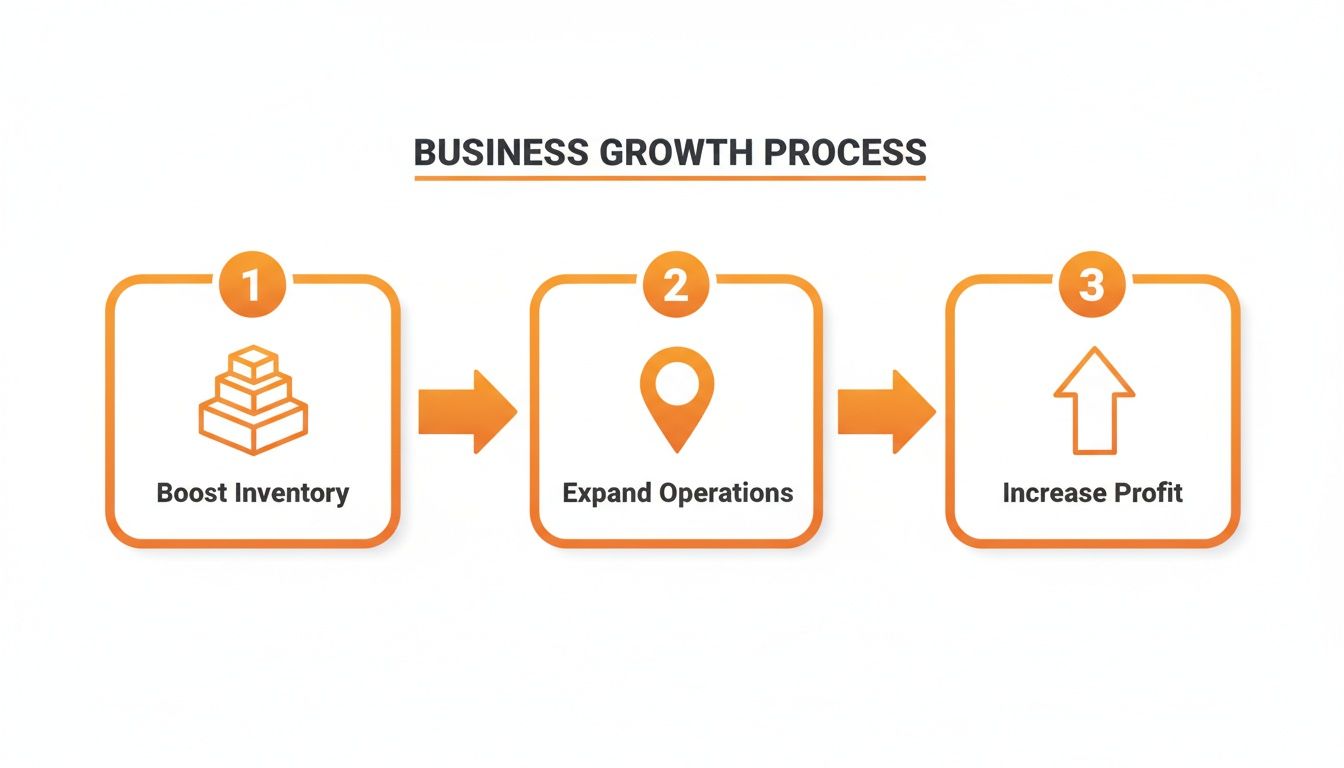
As you can see, a well-chosen unit isn't just a place to dump things. It’s a tool for boosting inventory, expanding your operational reach, and ultimately, increasing your bottom line.
Matching Size to Your Business Inventory
Visualising how your stock, equipment, or documents will actually fit into an empty space is often the trickiest part. It’s a common trap: businesses either overestimate what they need and waste money on empty air, or they underestimate and face a logistical nightmare trying to cram everything in. Don't leave it to guesswork.
To give you an idea, a 5×10 foot unit is often perfect for a small e-commerce business holding a few dozen boxes of stock or a tradesperson who just needs to store hand tools and supplies. Step up to a 10×20 foot unit—roughly the size of a single-car garage—and you can comfortably house excess furniture for a home staging business or bulky equipment for a construction firm.
Here's a quick reference to help you match your needs to the right size.
Matching Your Business Needs to Storage Unit Size
| Unit Size (sq ft) | Equivalent To | Ideal For Storing |
|---|---|---|
| 25-50 | Large walk-in wardrobe | Document archives, a few dozen stock boxes, marketing materials. |
| 50-100 | Large garden shed | Small e-commerce inventory, tools for a sole trader, office supplies. |
| 100-150 | Half a single garage | Excess furniture for a small office, equipment for a small crew. |
| 150-200 | Standard single garage | Palletised stock for retail, construction equipment, large trade tools. |
| 200+ | Double garage or larger | Bulk inventory, light machinery, entire office contents during a move. |
This table should give you a solid starting point for shortlisting potential units.
The goal is to rent the smallest space that will comfortably and safely hold your items. An organised, slightly larger unit is always more efficient than a smaller, overstuffed one where you can't find a thing.
If you’re still on the fence, a detailed self-storage unit size guide can offer some great visual comparisons to help you make the final call. Nailing the size from day one saves a huge amount of time and money.
To make sure you choose a facility that truly supports your operations, it helps to look at guides that compare different options, like this Perth's ultimate guide to storage units. These resources can bring features and providers to your attention that you might not have considered. By carefully weighing up the size, location, and specific features, you can find a unit that acts as a genuine asset for your company.
Evaluating Security and Access for Business Assets
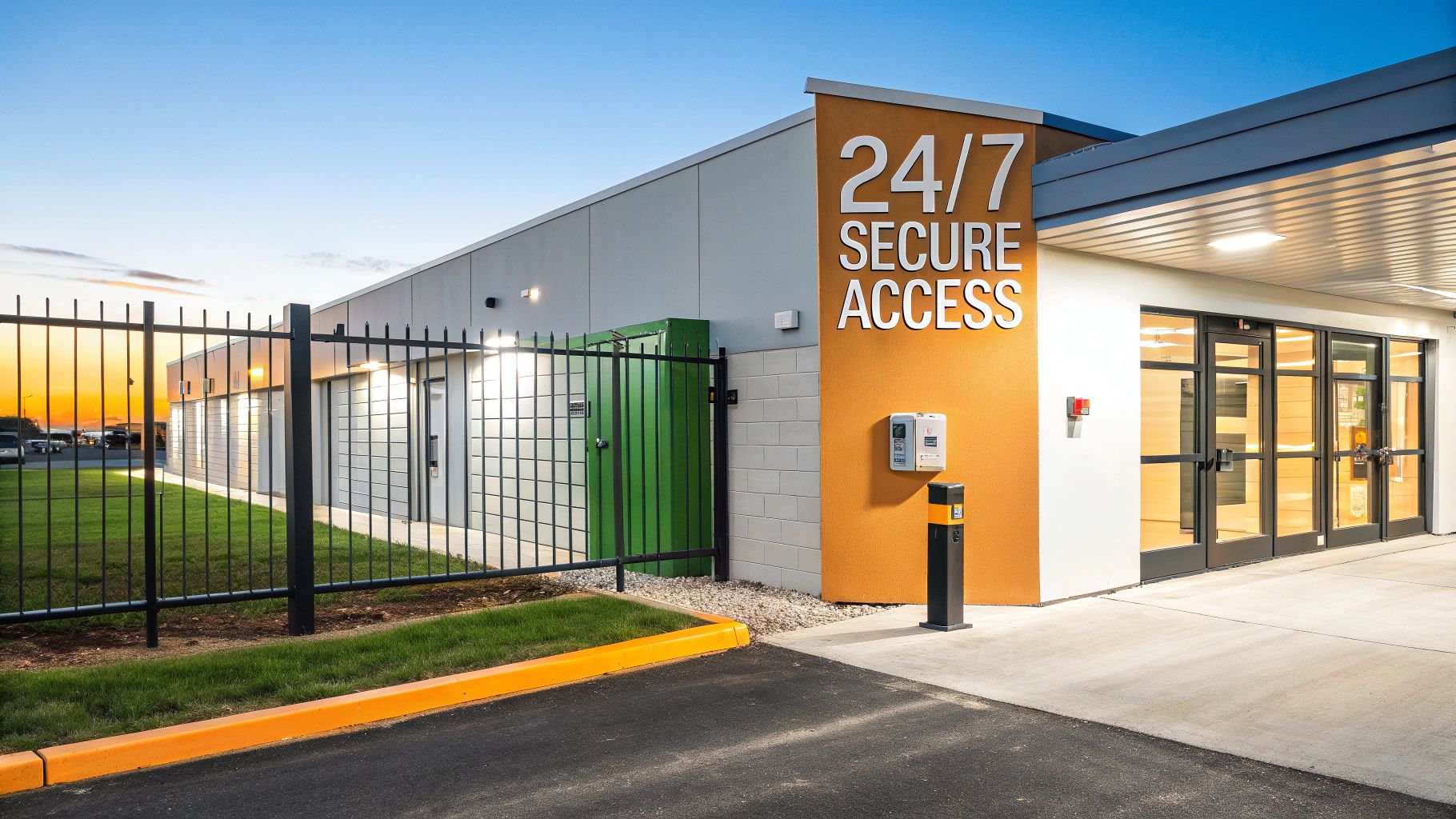
When your business's assets are on the line, baseline security just doesn't cut it. Storing your inventory, equipment, or archives in a third-party facility means you need absolute confidence in their protective measures. It’s not just about a padlock on a door; it’s about a multi-layered system designed to deter, monitor, and control who comes and goes, day or night.
Think of it like this: a single lock is a single point of failure. Proper security for business assets involves overlapping systems that work together. This starts right at the perimeter—is there high, secure fencing that clearly marks the property and discourages anyone from trying their luck? From there, you need to see comprehensive CCTV coverage. And I’m not talking about a single, grainy camera over the main gate, but multiple high-definition cameras monitoring key access points, driveways, and corridors 24/7.
Beyond the Basics of Facility Security
The best facilities take security a step further. Controlled electronic gate access is non-negotiable, ensuring only registered clients can enter the premises using a unique PIN or fob. Some of the top-tier storage units for business also offer individual unit alarms, adding another crucial layer of protection right at your door. This combination means that even if someone manages to get past the main gate, your specific unit is still locked down tight.
Here’s what your security checklist should absolutely include:
- Secure Perimeter Fencing: A well-maintained and high fence is the first line of defence.
- 24/7 CCTV Monitoring: Ensures all activity is recorded and can be reviewed if there's ever an issue.
- Electronic Gate Access: Restricts entry to authorised people only and creates a log of all movements.
- Sufficient Lighting: Well-lit corridors and outdoor areas are a massive deterrent to would-be thieves.
- Individual Unit Alarms: Offers peace of mind that your specific space is being monitored.
Finding a facility that ticks all these boxes is vital. For a deeper dive into what to look for, exploring guides on finding secure storage near me can give you some valuable local insights and standards.
Why Access Hours Are an Operational Decision
Security is only half the story; access is the other. Your business probably doesn't stick to a neat 9-to-5 schedule. For a tradesperson needing to grab tools at 6 a.m. or an e-commerce owner packing orders late at night, restricted access is a complete dealbreaker.
Operational flexibility is key. A storage unit should work for your business, not against it. If you can't get to your stock or equipment when you need it, the unit becomes a liability rather than an asset.
Before you even think about signing a contract, confirm the facility's access hours. While many offer extended hours, true 24-hour access provides the ultimate freedom, letting your business operate on its own schedule without constraints. This isn't just a minor perk—it's an essential feature that directly impacts your efficiency and your ability to serve your customers. Choosing a unit that nails the balance between robust security and unrestricted access is one of the smartest logistical decisions you can make.
Organising Your Unit for Maximum Business Efficiency
A disorganised storage unit isn't just an inconvenience; it's a direct drain on your business's efficiency. Every minute spent digging for a specific item is a minute you're not spending on fulfilling orders or serving clients. The trick is to stop thinking of it as a storage cupboard and start treating it as a small, streamlined warehouse—an active and productive extension of your daily operations.
This shift in mindset is crucial. An online retailer, for example, wouldn't just toss boxes of stock into a room. They'd organise it by SKU, season, or best-sellers to make order fulfilment lightning-fast. Your approach to using storage units for business should be just as methodical, regardless of what you're storing.
Creating a Strategic Layout
Before you even think about moving a single box in, sketch out a simple floor plan. Your number one rule should be to create a clear central walkway running from the door to the back of the unit. This one simple action prevents the dreaded "wall of boxes" that makes getting to anything at the rear impossible without unloading the entire space.
Position your most frequently accessed items right at the front, near the door. Whether that’s fast-moving inventory, daily-use tools, or essential marketing materials, having them close to hand minimises the time and effort needed for everyday tasks.
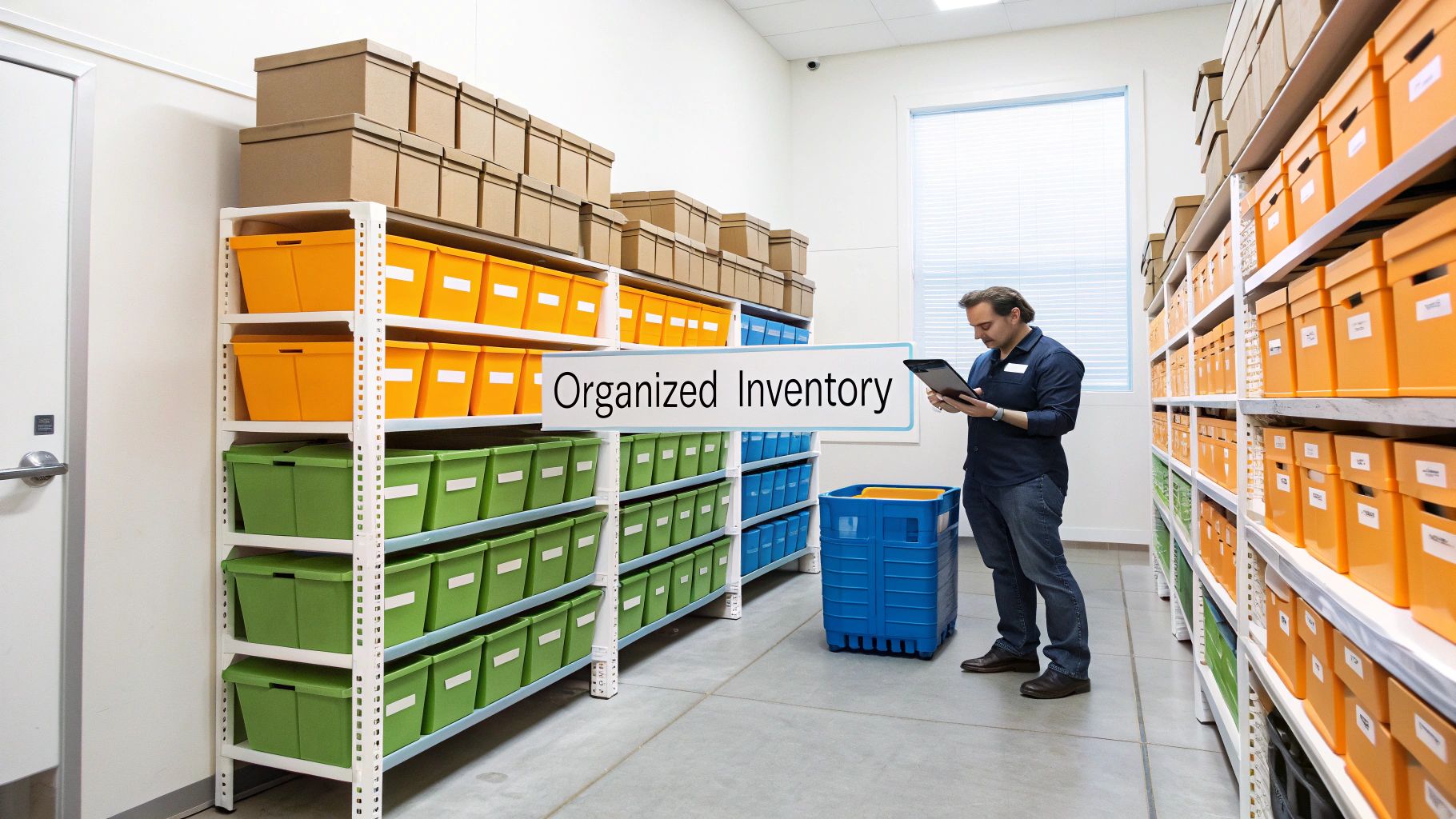
Don’t forget to think vertically. Investing in sturdy, free-standing shelving units gets your boxes off the floor, which not only maximises your usable space but also protects your items from potential ground moisture and improves air circulation.
Systems for Smart Inventory Management
A logical layout is the foundation, but a clear system is what makes it truly work for you. Without one, you're just guessing where things are.
Here are a few professional tips to get you started:
- Use Uniform Bins: Ditch the random assortment of cardboard boxes. Using clear, stackable plastic bins of the same size gives your unit an organised look and lets you see the contents at a glance.
- Label Everything Clearly: Every single box or bin needs a clear, bold label. Don't just write "Office Supplies"—get specific with "A4 Paper, Ink Cartridges, Notepads." For stock, include the SKU, product name, and quantity.
- Create a Digital Inventory: This doesn't need to be complicated. A simple spreadsheet listing each box's contents and its general location (e.g., "Aisle 1, Shelf 3") can be a total game-changer. This digital map is invaluable for finding what you need in seconds.
Think of your storage unit layout as a user interface. It should be intuitive, predictable, and designed to help you find what you need with the fewest possible clicks—or, in this case, steps. A well-organised space saves countless hours over the long term.
For a deeper look into a practical setup, our guide on how to effectively organise your self storage container offers more detailed strategies. By putting these simple but powerful techniques into practice, you can transform your storage unit from a chaotic liability into a highly efficient operational hub that actively supports your business growth.
Making the Most of Your Storage Unit Investment
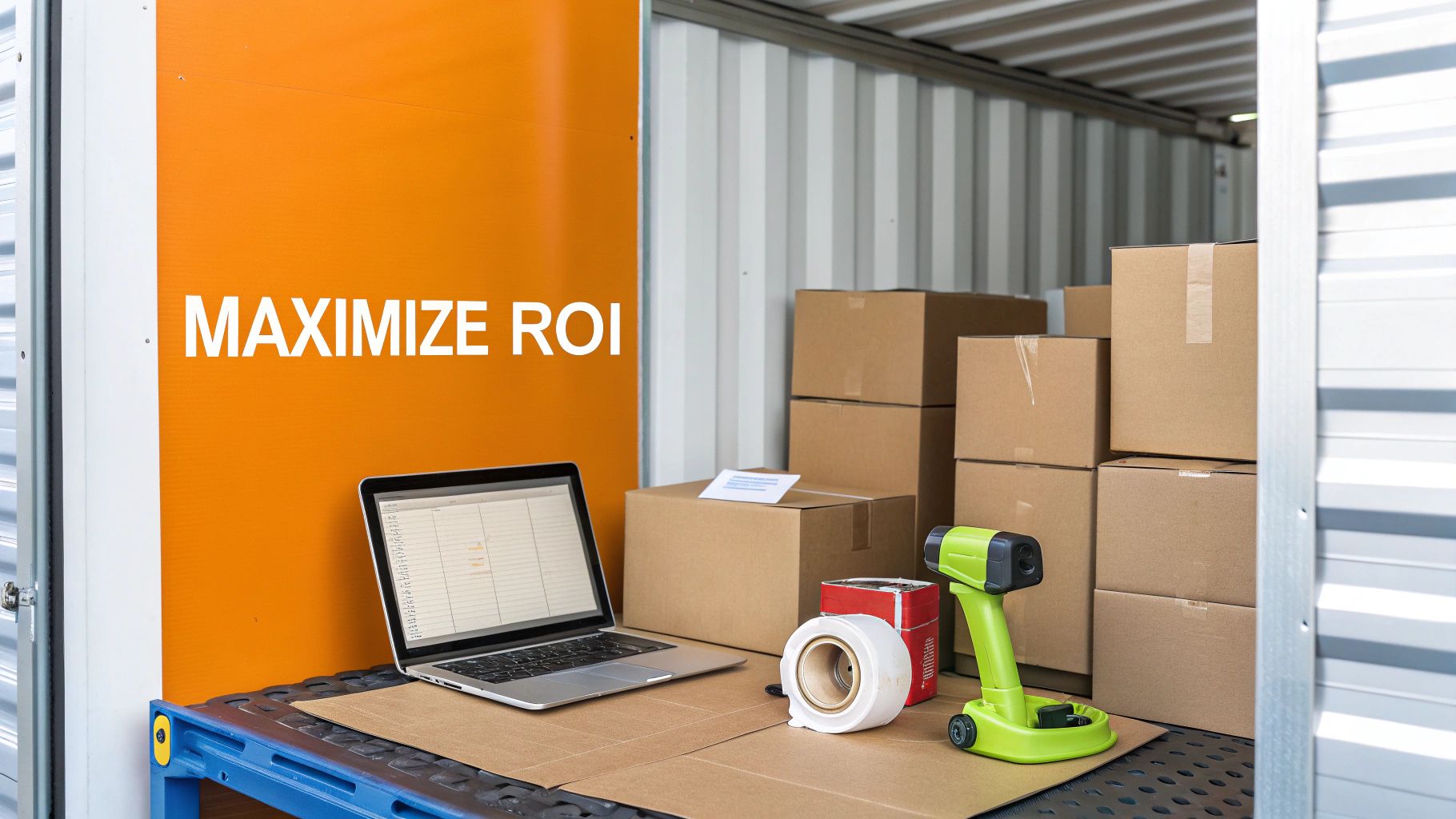
So, you're paying the monthly rent on a business storage unit. But is it just a cost on your P&L sheet, or is it actively working for you? The smartest businesses I've worked with don't see their unit as just a place to stash excess stock. They treat it as a flexible, low-cost operational base that can save time, slash overheads, and give them a real competitive edge.
It’s time to rethink what a storage unit can actually do for your business. It's not just about overflow; it's about creating a strategic advantage.
Creative Ways to Use Your Business Storage
To really squeeze every drop of value from your investment, think beyond the basics. Here are a few advanced strategies that turn a simple storage space into a powerful operational hub.
- Set up a micro-fulfilment centre. If you’re in e-commerce, a strategically placed unit can be a game-changer. Stock your most popular products locally, and you can offer faster, cheaper deliveries that will delight your customers and cut your shipping times dramatically.
- Create a central hub for remote teams. For businesses with sales reps or service technicians in the field, a unit is the perfect command centre. It’s a secure, centralised spot to store marketing materials, product samples, or specialised equipment that staff can access whenever they need it.
- Build a secure document archive. Ditch the bulky filing cabinets taking up prime office real estate. A climate-controlled unit is the ideal place to create a dedicated archive for your critical business documents, keeping them protected from damage but still easily accessible.
These aren't just hypotheticals; this is how storage units for business become a core part of a growth strategy. It’s about creating efficiencies you just can't get with traditional commercial property.
Think of your unit as a flexible extension of your business premises. By taking advantage of its low cost and high accessibility, you can build leaner, more agile processes without the crippling burden of a long-term lease.
I know a local tradesperson who uses their unit as a daily dispatch point. They get material deliveries sent straight to the facility, load up their van each morning, and keep their valuable tools securely locked away overnight. It keeps their home address private and saves them hours every single week—that’s a direct boost to their profitability.
Getting to Grips with Costs and Contract Small Print
Right, let's talk money. Before you commit to a business storage unit, you need to be crystal clear on what you're actually paying for. The monthly rental fee you see advertised is almost always just the starting point. To make a smart financial move, you’ve got to dig a bit deeper and uncover the full picture, including deposits, insurance, and any other little fees that might pop up.
One of the best things about self-storage compared to traditional commercial property is the flexibility. You’re not getting locked into a rigid, multi-year lease. Most facilities run on a simple month-to-month basis, which is a massive win for any business watching its cash flow. It gives you the freedom to scale up or down as your needs change, without getting hit with massive penalties.
What’s the Real Cost of a Business Unit?
To sidestep any nasty surprises on your first invoice, you need a full breakdown of all potential charges. The total cost is more than just the rent—it’s a mix of a few key things that can differ from one facility to the next.
Here’s what you should be looking for:
- Security Deposit: This is standard practice. It’s a refundable amount held in case of damage or missed payments. Make sure you ask exactly what you need to do to get it back in full when you leave.
- Insurance: You’ll almost certainly need insurance for your goods. You might be able to extend your existing business policy, but many facilities offer their own specialised plans that are surprisingly affordable.
- Admin Fees: Some places charge a one-off fee for setting up your account and getting the paperwork sorted.
- Locks and Supplies: In nearly every case, you’ll need to buy your own padlock. Don't skimp on this—get a good one.
The good news? The UK self-storage market is pretty competitive, which keeps a lid on prices. Rental returns recently saw a 6% bump to an average of £29.13 per square foot each year, with the national average hovering between £27-£30. This growth is a testament to the industry's value, which now boasts over 64.3 million square feet of space across the country. You can dive deeper into these figures with these UK storage market trends from The Box Co.
Key Questions to Ask About the Storage Contract
Before you put pen to paper, it’s time to scrutinise the small print. That rental agreement is there to protect both you and the storage provider, so give it a proper read-through. Don’t be shy about asking direct questions until you’re 100% happy with the terms.
A storage contract shouldn't feel like a trap. It should be a clear, straightforward agreement that outlines expectations. If anything seems ambiguous, ask for clarification in writing. This simple step can save you significant hassle later.
Pinpoint these critical details and get clear answers:
- Notice Period: How much warning do you need to give before you move out? The most flexible providers often only ask for a week or so.
- Price Increases: Find out how and when your monthly rate could go up. Do they review prices annually?
- Late Fees: What happens if a payment is late? Get the details on any grace period and what the fees are.
- Prohibited Items: Every facility has a list of things you can't store. Double-check it to make sure your inventory is compliant.
- Access Rules: Confirm the access hours and any specific rules about staff visits or accepting deliveries.
By giving both the costs and the contract a thorough vetting, you can be confident that your choice of storage units for business is a sound investment that will genuinely support your operations.
Still Have Questions About Business Storage?
When you’re weighing up your options, a few final questions usually come to mind. Making the right decision is crucial, so here are some straightforward answers to the common queries we hear from businesses looking into self-storage.
Let's get into the practical side of things—logistics, rules, and the kind of flexibility that makes storage units for business such a powerful tool.
Logistics and Deliveries
Can I get deliveries sent straight to my business storage unit?
Absolutely. Most modern facilities are well-equipped to handle business deliveries, which is a massive time-saver for e-commerce companies or any business managing physical stock. It's always a good idea to have a quick chat with the site manager first just to confirm their specific policy.
Some sites even offer a service to accept packages on your behalf. This can be a huge help, preventing missed deliveries and saving you from making unnecessary trips to the unit.
Prohibited Items and Safety
What kind of business items are not allowed in a storage unit?
For clear safety and insurance reasons, certain items are universally off-limits. You need to know these restrictions to make sure you're staying compliant with your rental agreement.
A typical list of forbidden items includes:
- Hazardous Materials: Anything flammable, corrosive, or explosive is a strict no-go.
- Perishable Goods: Food and other perishable items can attract pests, so they are not allowed.
- Living Things: This one’s pretty obvious—no plants or animals.
- Illegal Substances: Storing anything illegal is strictly forbidden.
Always double-check the rental agreement for a complete list, as this is a critical part of your contract. Breaking these rules can lead to immediate eviction and potential legal headaches.
Scalability and Business Growth
How quickly can I change my unit size if my needs change?
This is where self-storage really shines for businesses. Most facilities make it incredibly easy to upsize or downsize as your needs evolve—an agility that traditional commercial leases just can't offer.
As your inventory ebbs and flows with seasonal demand or business growth, you can typically switch to a different-sized unit based on availability. The process is usually as simple as talking to the facility manager.
This built-in scalability is a financial lifeline for growing businesses. You only ever pay for the space you need right now, avoiding the high costs and long-term chains of a fixed commercial lease. You can adapt your physical footprint in real-time, responding directly to what the market is telling you.
This flexibility lets you manage your overheads far more effectively, ensuring your storage solution grows with you, not ahead of you. It transforms a potential fixed cost into a manageable, variable expense, freeing up capital for other areas of your business. The ability to pivot quickly without penalty is a huge competitive advantage.
Ready to find a flexible, secure space that adapts to your business needs? At Standby Self Storage, you can check prices, book a unit, and move in today with no long-term commitments. Find your perfect business storage solution at https://www.standbyselfstorage.co.uk.